

Every few years, a new wave of digital tools arrives and sparks fresh debate about whether print advertising still has a place in marketing. The answer, consistently, is yes—but only when it’s done right. Print isn’t competing with digital. The two work best together. A well-designed print ad can drive website traffic, reinforce a brand identity established online, and reach audiences that digital channels routinely miss. The problem is that many marketers treat print as an afterthought, recycling digital assets and wondering why the results fall flat.
Print advertising operates by different rules. It demands sharper visual communication design, more deliberate layout decisions, and a deep understanding of how people physically interact with media. A scrollable feed and a magazine spread are fundamentally different experiences—and your creative approach needs to reflect that.
This guide covers the key best practices for print advertising in modern marketing, from design fundamentals to production considerations, so you can create print campaigns that earn attention and deliver results.
Why Print Advertising Still Matters in a Digital World
Before diving into execution, it helps to understand what makes print uniquely valuable. Physical media creates a different kind of engagement. According to research by Canada Post, direct mail requires 21% less cognitive effort to process than digital media, and produces a 70% higher brand recall rate. Readers engage more slowly, absorb information more deeply, and are less likely to be simultaneously distracted by notifications or competing content.
Print also builds credibility. A brand featured in a respected publication benefits from the trust readers already extend to that outlet. This halo effect is harder to replicate with a display ad. For marketers, the practical implication is clear: print advertising reaches people in a different mental state than digital advertising does. That’s not a limitation—it’s an opportunity, provided you design for it.
How to Define a Clear Objective for Your Print Ad
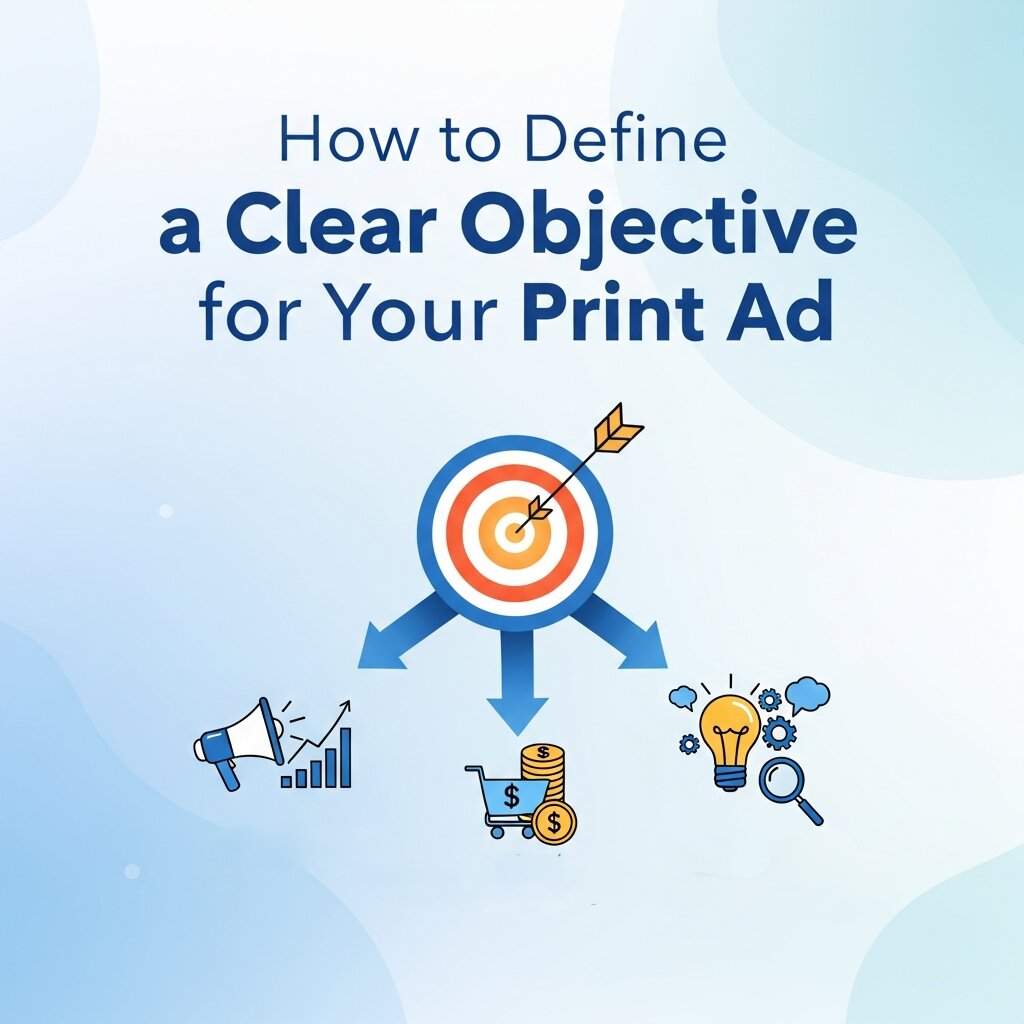 Every effective print ad starts with a single, well-defined objective. This sounds obvious, but it’s where many campaigns go wrong. Print ads that try to do too much—introduce a product, explain a promotion, build brand awareness, and drive a purchase—end up doing none of it well. Space is limited. Reader attention is even more so.
Before briefing your creative team, answer this question: what is the one thing you want a reader to do, think, or feel after seeing this ad? From there, every creative decision—headline, imagery, layout, call to action—should serve that single objective. If an element doesn’t contribute to it, cut it.
Mastering Visual Communication Design in Print
Visual communication design is the backbone of any successful print ad. Unlike digital formats, where animation, interactivity, and retargeting can compensate for weak creative, print has no second chance. The ad either works on the page, or it doesn’t.
Use a Strong Visual Hierarchy
Visual hierarchy guides the reader’s eye through the ad in a deliberate sequence. The most important element—usually the headline or hero image—should command attention first. Secondary information follows naturally, with the call to action closing the sequence.
A common mistake is treating all elements as equally important, resulting in a cluttered layout where nothing stands out. Print advertising rewards restraint. Give your primary element space to breathe, and let supporting content play a supporting role.
Choose Typography With Intention
Typography in print does more than convey words—it communicates tone, urgency, and brand personality. A few principles to keep in mind:
- Limit your typefaces. Using more than two or three fonts in a single ad creates visual noise. One strong typeface, used well, is almost always more effective.
- Prioritize legibility over aesthetics. A decorative font that looks great on screen may be difficult to read when printed at smaller sizes. Always proof your typography in the actual print dimensions.
- Consider how type interacts with imagery. Text placed over a busy background loses impact. Use contrast, negative space, or color blocking to keep your headlines sharp and readable.
Apply Color Psychology Deliberately
Color is one of the most powerful tools in visual communication design, and one of the most misused. Different colors trigger distinct emotional responses—blue conveys trust and reliability, red signals urgency or passion, green evokes nature and calm—but these associations only matter if the color choices align with the brand and the message.
More importantly, color decisions in print must account for the printing process itself. Colors that look vivid on screen can appear dull or shifted when printed, particularly if CMYK values aren’t properly calibrated. Always request physical proofs before approving a final print run.
Applying Digital Graphic Design Principles to Print
 Designers who primarily work in digital environments—building UI/UX visual design for apps, websites, or social media—bring valuable skills to print projects, but they also need to adapt their thinking.
Digital graphic design is built around pixels, screens, and interactivity. Print design is built around ink, paper, and fixed dimensions. The shift requires attention to a few key differences.
Resolution matters more in print: Digital images are typically 72 DPI (dots per inch). Print requires a minimum of 300 DPI to reproduce cleanly. Using low-resolution digital assets in print will result in blurry, unprofessional output.
Bleeds and margins are non-negotiable: Print layouts require a bleed area—typically 3mm beyond the trim edge—to account for slight variations in cutting. Failing to set up bleeds correctly leads to white borders appearing where none were intended.
File formats differ: Digital graphic design outputs are often JPEGs, PNGs, or GIFs. Print requires high-resolution PDFs, EPS files, or layered TIFFs. Working in the wrong format from the start creates problems that are difficult and costly to fix late in the production process.
Designers transitioning from UI/UX visual design to print should also rethink interactivity. Hover states, animations, and clickable elements don’t translate to a static page. The design must communicate everything it needs to without any dynamic behavior—which often means simplifying layouts and leaning harder on the strength of a single visual idea.
Writing Copy That Works in Print
Strong print advertising copy is concise, specific, and built around a reader benefit—not a product feature. The headline carries the most weight. It needs to stop a reader mid-page and give them a reason to keep reading. The best headlines are specific rather than clever, direct rather than vague. “Cut your energy bill by 30%” outperforms “Saving made simple” every time.
Body copy, when included, should be short. Print readers rarely pause to read paragraphs of text. Use the body copy to support the headline’s promise with one or two concrete details, then lead cleanly into your call to action. The call to action deserves particular attention in modern print advertising. Rather than a generic instruction like “Visit our website,” give readers a specific destination—a dedicated landing page URL, a QR code, or a promo code that also lets you track campaign performance.
How to Integrate Print Advertising With Digital Campaigns
Print advertising doesn’t have to operate in isolation. When connected to digital channels, it becomes significantly more measurable and more effective. QR codes are the most practical bridge between print and digital. A QR code printed on a magazine ad or direct mail piece can send readers to a campaign-specific landing page, a video, a product page, or an exclusive offer. This creates a trackable path from print exposure to online action.
Dedicated URLs and promo codes serve a similar function. When a reader types in a URL seen only in a specific print ad, or redeems a code unique to that campaign, you gain direct evidence of print-driven conversions. These integrations also allow A/B testing across print placements. Running the same ad in two publications with different promo codes reveals which audience or context performed better—something previously difficult to measure in print.
Production Considerations That Protect Your Creative Work
Even the strongest print advertising concept can be undermined by poor production decisions. A few considerations that experienced print marketers never overlook:
Paper stock affects perception: Glossy paper communicates premium quality. Uncoated stock feels more approachable and tactile. Recycled paper signals environmental values. The material your ad is printed on sends a message before a single word is read.
Printing method affects color accuracy: Offset printing delivers superior color consistency for large runs. Digital printing is more cost-effective for smaller quantities but may produce slightly different results. Understand which method your printer is using, and request proofs accordingly.
Proofing is mandatory: Never approve a print ad based solely on a screen preview. Colors shift, fonts can render differently, and layout issues invisible on screen become obvious in print. A physical proof saves significant money and embarrassment.
Measuring the Effectiveness of Print Advertising
 One of the most persistent criticisms of print advertising is that it’s difficult to measure. That’s less true today than it once was. Beyond QR codes and unique URLs, marketers can measure print effectiveness through post-campaign surveys (asking customers where they first heard about a brand), coupon redemption tracking, and lift analysis—comparing sales performance in regions where print campaigns ran against those where they didn’t.
Attribution modeling, increasingly used in integrated marketing strategies, can also account for print’s contribution to a conversion journey that spans multiple touchpoints. The goal isn’t perfect attribution—it rarely is in any channel. The goal is enough evidence to make informed decisions about where print advertising fits in your broader media mix.
Frequently Asked Questions (FAQs)
1. What is print advertising?
Print advertising is a form of offline marketing that promotes products, services, or brands through physical media such as newspapers, magazines, brochures, flyers, catalogs, posters, and direct mail. It helps businesses increase brand awareness and engage audiences in a tangible format.
2. Is print advertising still effective in the digital age?
Yes. Print advertising remains effective because it offers higher brand recall, builds credibility, and reaches audiences in distraction-free environments. When combined with digital marketing, it strengthens omnichannel campaigns and improves overall marketing performance.
3. What are the main types of print advertising?
Common types include newspaper ads, magazine advertisements, brochures, flyers, catalogs, direct mail, posters, banners, billboards, inserts, and promotional booklets. The right format depends on your target audience, campaign objectives, and budget.
4. How can businesses create an effective print advertisement?
An effective print ad starts with a clear objective, compelling headline, strong visual communication design, concise copy, consistent branding, and a clear call to action. High-quality images and professional printing also play an important role.
5. What is the ideal image resolution for print advertising?
Print materials should use images with a minimum resolution of 300 DPI (dots per inch). This ensures sharp, professional-quality graphics and prevents blurry or pixelated images during the printing process.
6. How can print advertising be integrated with digital marketing?
Businesses can connect print and digital marketing by including QR codes, personalized URLs, social media handles, NFC technology, and promotional codes. These elements drive online engagement while making print campaign performance easier to measure.
7. What are the most common print advertising mistakes?
Frequent mistakes include overcrowded layouts, weak headlines, inconsistent branding, poor typography, low-resolution images, ignoring bleed and margin requirements, and failing to include a clear call to action or tracking method.
8. How do you measure the success of a print advertising campaign?
Success can be measured using QR code scans, unique landing page visits, coupon redemptions, promotional codes, customer surveys, phone call tracking, sales growth, and overall return on investment (ROI).
9. What role does visual communication design play in print advertising?
Visual communication design organizes typography, imagery, colors, spacing, and layout to guide readers’ attention and communicate messages effectively. Strong design improves readability, strengthens brand identity, and increases the likelihood of customer action.
10. Should businesses choose print advertising or digital advertising?
Rather than choosing one over the other, businesses often achieve the best results by combining print and digital advertising. Print builds trust and lasting brand recognition, while digital marketing offers broader reach, precise targeting, and real-time performance tracking.
Making Print Work for Modern Audiences
Print advertising rewards marketers who approach it with the same level of strategic and creative discipline they bring to digital campaigns. The fundamentals—clear objectives, strong visual communication design, purposeful typography, and well-crafted copy—remain constant. What changes is how those fundamentals are applied to a physical medium with its own production requirements, reader behaviors, and measurement challenges.
Used thoughtfully, print advertising doesn’t just hold its own alongside digital. It does things digital can’t: it sits on a kitchen table, waits in a waiting room, gets pinned to a noticeboard. Physical presence is a durable form of attention—and in a crowded media environment, that’s worth a great deal.



Leave a Reply